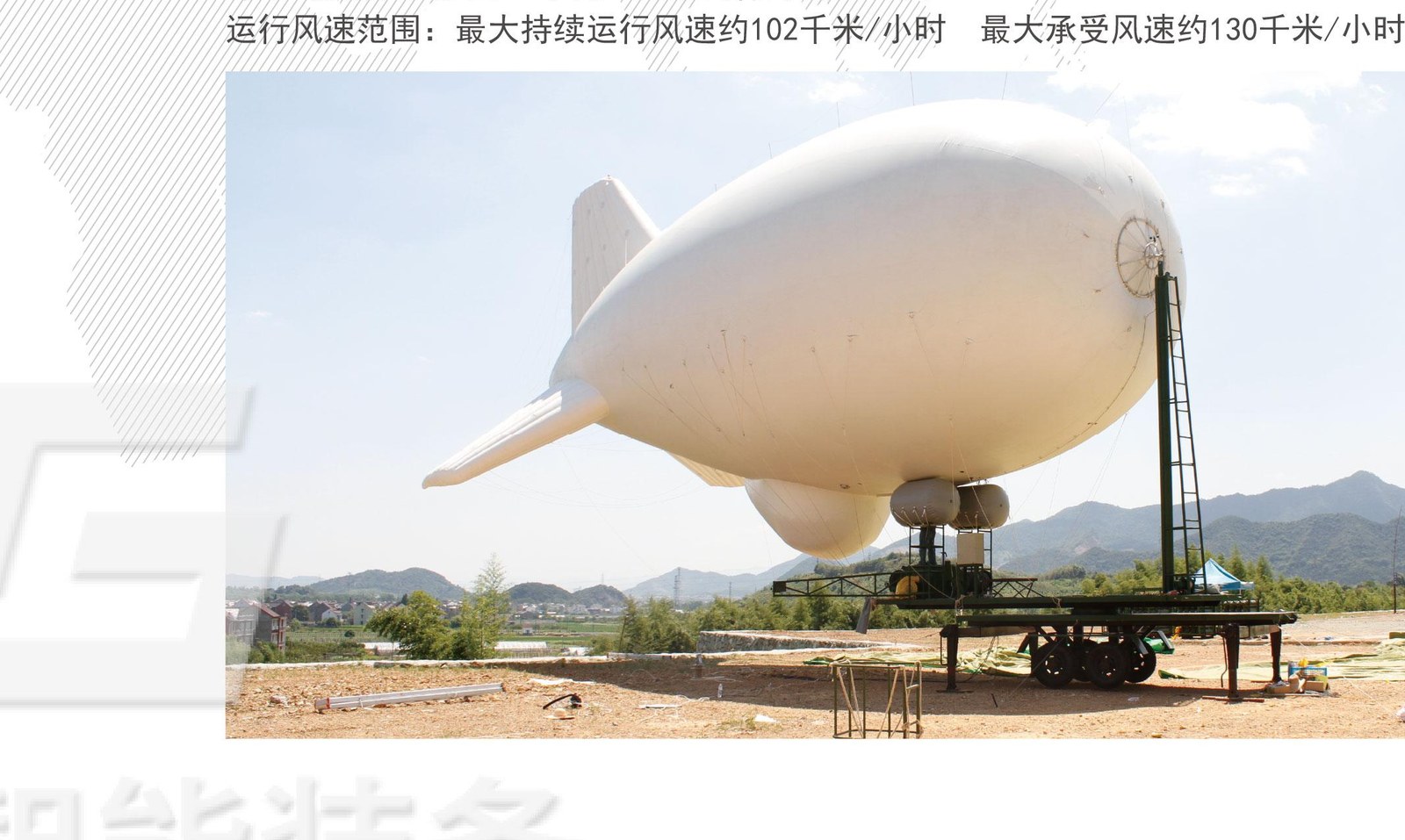
22 m tethered airship
A tethered airship used as an elevated sensor platform, combining the hull, mooring, winch, communications and power systems into one station.
A tethered airship used as an elevated sensor platform, combining the hull, mooring, winch, communications and power systems into one station.

A small helium-filled balloon on a two-axis stabilised turret, giving persistent day and night coverage over a 5 km radius with very low operating cost.
Other categories
Overview
Aerostats use a helium-filled aerodynamic envelope with a mooring and control system for continuous observation. The envelope is coated for UV and abrasion resistance, the tether carries power and data, and the ground station presents the operator with stabilised daylight and thermal imagery — a platform that stays on task for days rather than hours.
A helium-filled envelope, a mooring and winch system, and a payload — normally an electro-optical turret, a synthetic aperture radar, or a communications package. The whole system is designed to be transported and set up by the operating unit.
The tethered observation system operates continuously for about a week before it is brought down for helium top-up and inspection.
The integrated electro-optical turret and synthetic aperture radar track targets in real time out to roughly a 50 km radius, using the mast height to see well beyond the horizon a ground sensor could cover.
The system is rated to operate in winds up to Beaufort 7, and the mooring system holds the envelope stable enough for the payload to keep tracking.
Yes. The system runs stably at plateau and high-altitude sites down to −40 °C, which is where a tower or mast becomes impractical.
Yes. A tethered communications variant carries 5G base station equipment and a satellite backhaul link, giving roughly a 20 km coverage circle that can be established within hours of arriving at a site with no working network.
Border surveillance, disaster communications, meteorological monitoring and forest fire detection, where the requirement is persistence rather than speed.
01
Choose an open position with clear sightlines in the required sector, and check the airspace restrictions that apply.
02
Set the mast and winch and anchor them to the site ground conditions.
03
Fill the envelope with helium to the specified pressure and check it for leaks.
04
Attach the electro-optical turret, radar or communications package and connect power and data.
05
Pay out the tether and raise the aerostat to operating height, then set the tether tension.
06
Calibrate the turret or radar against known references and hand over to the ground control station.
07
Winch down, deflate or top up helium, and inspect the envelope, tether and payload.
| Minimum order | From 1 set — mixed models can share one container |
| Sample lead time | 72 hours for stock patterns |
| Documentation | Bid documents, test reports and certificate of origin |
| Customisation | Camouflage, unit markings, insignia and signature options |
| Service life | Over 200 inflation cycles in field conditions |
| Lead time & payment | Lead time and payment terms confirmed on enquiry |
Swipe to see more →
Tell us the platforms you need to simulate and we will confirm specification, lead time and payment terms in writing.
Send the platform type, the signature you need and the delivery country — any platform, from any origin. You get back a written specification, a lead time and an export quotation.
Request a quotation
Tell us what you need to protect and we will come back with a configuration and an export quotation.
Thank you — your enquiry has been prepared. We reply within one working day.